Program Notes for Psalmen Davids, May 1–3, 2026

Psalmen Davids

Three Centuries of Sacred Song
May 1–3, 2026

Embedded within many of the world’s religious scriptures are bodies of sacred song. The Jewish Tanakh (and thus the Christian Bible) contains the Tehillim, the Book of Psalms. Vedic Hinduism counts among its great texts the Samaveda, a collection of melodic chants. The central text of Sikhism, the Guru Granth Sahib, is composed as a series of extended hymns, and the Pali Canon of Buddhism features a large collection of mantras meant to be chanted. Throughout the world, sacred scripture has been transmitted through song for millennia, imbuing its words with extra-semantic meaning.

Most familiar to us in the West are the Psalms, the basis of thousands of compositions since time immemorial, and attributed in large part to King David of the ancient Kingdom of Israel. These texts were purportedly sung in the ancient Temple of Jerusalem by two antiphonal choirs, and this antiphonal scoring has survived, though less universally over time, to the present day. Composers have continued to turn to these texts not only because of their theological weight but because of their extraordinary expressive range, from lamentation to exultation and from intimacy to grandeur.

Heinrich Schütz’s (1585–1672) Psalmen Davids of 1619 stands out as a landmark in this tradition. This monumental collection of 26 psalm settings reflects both his Lutheran engagement with these texts and the deep influence his teacher, Giovanni Gabrieli, had on his compositional style. Schütz’s settings are deeply colorful and spatially oriented, featuring multiple choirs in dialogue with each other, instruments woven into the vocal textures, and sensitive expressions of their dramatic texts. As he so often did in his other works, Schütz labored intensively to bring the images in these texts to life in sound.

We close our 2025–2026 season today with selections from Schütz’s collection in dialogue with other composers’ settings of some of these same texts. We thus bring our season to a close as we opened it in the fall—with brilliant, polychoral settings of the psalms from the Renaissance and Baroque eras. That concert drew primarily from the body of cori spezzati settings of Vespers psalms composed in northern Italy during the mid-16th century, the first flowering of the Venetian School. Schütz, born a century after the first generation of those composers, arguably represents the apotheosis of this movement, having taken up its mantle from Gabrieli. Tonight’s concert therefore brings our season full circle by presenting the German Baroque culmination of this Italian Renaissance movement.

We open our program with Schütz’s setting of Psalm 2, the source of the bass aria Why do the nations rage and several subsequent movements of Handel’s Messiah. Schütz depicts the seething turbulence of an unholy world through rapid, violent interplay between two contending choirs, reinforced by larger masses of voices and instruments. These forces converge into a wall of sound suggestive of the blind rage to which two opposing armies might build, and we are left to wonder if Schütz might have had the opening conflicts of the nascent Thirty Years’ War in his mind as he set this text. Reduced forces depict the unrighteous conspiracy to “throw off the bonds” of God and God’s subsequent laughter at the futility of these plans, and Schütz brilliantly varies textures and harmonic colors as the text turns from narrative to doctrine. The customary doxology that follows the psalm’s text begins sedately, though it gradually builds in texture and rhythmic complexity before finishing with a majestic “Amen”.

We then move to Felix Mendelssohn’s (1809–1847) setting of the same text, composed more than 200 years later, near the end of his tragically short life. Though separated by centuries, the similarities between these two settings are there to be uncovered. Most apparent are the similarities in scoring—much like Schütz’s setting, Mendelssohn’s employs two choirs in dialogue which, from time to time, give way to small corps of soloists. Mendelssohn also periodically borrows some of Schütz’s pungent harmonic changes, and his doxology likewise begins humbly and beautifully before growing to a climactic finish. With a less pictorial and more lyrical style, Mendelssohn more subtly evokes many of the same images as Schütz. On hand with us tonight, as you heard in our opening selection, is a band of instruments from the Jubilate Baroque Orchestra, and they will interject at various points during this setting.

Dramatically and compositionally, Psalm 100 is Psalm 2’s opposite—a short, self-assured psalm of praise. Both settings of this psalm on our program are likewise short and uplifting, though neither lacks variety or musical intrigue. Schütz’s setting, befitting the relative simplicity of the text, is scored for two equal four-voiced choruses. The two choirs trade rhythmically dynamic phrases in short, rapid-fire bursts, though these are punctuated by occasional respites of longer note values. The doxology that concludes this setting is more akin to Mendelssohn’s than any other such example on the program, its canonical, delicate, and transparent texture building inexorably to a climactic finish.

Its complement is sourced from another landmark collection by another singular composer, HaShirim asher l’Sh’lomo of Salamone Rossi (c. 1570–1630). Rossi’s life and career were defined in part by his relationship, as a Jew, with the upper echelons of contemporary Italian society. Overcoming the second-class citizenship to which his birth consigned him, he managed to find favor as a court musician to Duke Vincenzo I of Mantua. Rossi lived and worked during a time of great controversy within the Jewish communities of northern Italy, as these communities furiously debated whether and how to modernize worship in the synagogue. “We raise our voices on the festivals and sing songs of praise in the synagogue to honor God with compositions of vocal harmony,” wrote Rabbi Yehudah Mi-Modena, Rossi’s most prominent advocate. “A man stood up to chase us away, saying that it is not right to do so, because it is forbidden to rejoice, and that the singing of hymns and praises in harmony is forbidden. Although the congregation clearly enjoyed our singing, this man rose against us and condemned us publicly, saying that we had sinned before God!”

It was against this backdrop that Rossi composed the 33 polyphonic motets of HaShirim asher l’Sh’lomo, which translates as “The Songs of Solomon”—a clever pun on his own name. These motets demonstrate that Rossi had thoroughly imbibed the compositional style of his Catholic predecessors. Save for their Hebrew texts, they are scarcely distinguishable from the motets written by Palestrina or any of Rossi’s contemporaries who partook of the stile antico. His setting of Psalm 100 is a prime example: alternating sections of homophony and imitative polyphony periodically bring us to traditionally constructed cadences, and varying configurations of its five-voice texture (typical of late 16th-century writing) heighten the rhetorical power of the text before its climactic conclusion.

Schütz was a famously pragmatic composer—partly by necessity, as the Thirty Years’ War claimed more and more of his musicians as the conflict wound on—and he gave performers of his music explicit permission to take license with its performance. We exercise such license today, departing in several places from the practices Schütz probably intended, including in the next selection, his setting of Psalm 23. So flexible is Schütz’s writing that this piece, the first you will hear today scored for a small choir (the coro favorito) singing in a higher register and a larger group in a lower register, works well for a wide variety of forces. Today you will hear a quartet of soloists—sometimes reinforced by strings and a cornet—staffing the first group and a quartet of winds the second. As in other motets he wrote for this combination, Schütz reserves his most florid and pictorial melodies for the coro, while the second group periodically interjects to move the text and musical development forward.

Next up on our program are two settings of Psalm 84, which lovers of Brahms’ Ein Deutsches Requiem will recognize as the text of that work’s keystone movement. Schütz’s unusual setting of this text displays his expressive powers. Like the previous selection, it is scored for “high” and “low” choirs, though it easily surpasses it in harmonic and melodic richness. The first three chords of this motet form one of the most striking openings in Schütz’s entire output, and the setting never lets up, twisting and turning through unexpected modal shifts, extended imitative developments, dense canons at the unison, and a relatively rare episode of ensemble recitative. Fittingly, it likewise ends in unusual fashion through its omission of the customary doxology.

We then travel back in time once again to the late Renaissance for this motet’s complement, a setting by Jacobus Gallus (alias Jacob Handl, 1550–1591). Gallus’s music, like Rossi’s, embodies the sacred style of the late Renaissance, though it makes use of more pungent harmonic changes and a great deal more syncopation than that of his contemporaries, perhaps foreshadowing the greater expressiveness of the music of the following century. His Latin setting of Psalm 84 typifies this approach, with occasional harmonic surprises and long, drawn‑out phrases that frequently move perpendicularly to the prevailing tactus and textual stresses. True to the conventions of the day, however, both choirs, antiphonally trading verses of text for much of the piece, converge to close the first part of the motet (we omit the second part today). Perhaps the greatest curiosity of this setting is the appearance, during these closing cadences, of triplets in both bass parts—an extremely rare device for music of this era.

We close our concert, and our season, with the most exuberant piece on this program, Schütz’s setting of Psalm 136. This motet truly has it all: striking scoring, an unusual degree of harmonic complexity (for how little harmonic ground is covered), and a wealth of musical fireworks. In addition to the familiar coro favorito, capella, and continuo, this piece features a cantor, trio of trombones, and a corps of trumpets and drums, gamely staffed tonight by our cornettists. Schütz ingeniously gives musical voice to this unusually constructed psalm, with its interlinear refrain of “For his goodness endures forever”, by assigning that refrain to the capella, and their repetitions likewise endure (seemingly) forever—far beyond the text of the psalm proper. As the piece develops, these refrains accelerate and increase in manic energy until they dissolve into a whirl of polyphonic repetitions. Striking, too, is the stubborn harmony of C major to which these refrains nearly always revert—regardless of the surrounding content—making for several harmonic changes reminiscent of Schütz’s Psalm 84, though achieved in the opposite manner and deriving from clearly different textual motivations. 

This wild, joyous whirlwind is a fitting way to close our concert and our season, and we hope we will see you in October for our presentation of Handel’s exquisite Funeral Anthem for Queen Caroline. We thank you for your support this season, and we hope you will spread the word about CBS! We wish you a restful, refreshing, and musical summer, and look forward to seeing you in the fall as we kick off another season of great music.

Meet Our Soloists for On Leaving, Feb 27–Mar 1

On Leaving

Music for Parting and Passage
February 27, 28, March 1, 2026

Tenor Corey Head specializes in early music with a special affinity to J.S. Bach. His solo concert performances include The Evangelist in Bach’s St. John Passion, as well as tenor soloist in his Magnificat, Christmas Oratorio, B-Minor Mass, and many of his cantatas. Other oratorio roles include Uriel in Haydn’s Creation, “The Evening” in Telemann’s Die Tageszeiten, and tenor soloist in Handel’s Messiah

Corey has appeared with CBS as tenor soloist in the Biber Requiem and Steffani Stabat Mater, as well as the recent Christmas concert. He has also performed solos in Mozart’s Requiem, Orff’s Carmina Burana, Britten’s Rejoice in the Lamb, William Boyce’s Solomon: A Serenata, Handel’s Acis and Galatea, Beethoven’s Mass in C Major, and Mozart’s C Minor Mass.

Operatic performances include the roles of Ferrando in Mozart’s Così Fan Tutte, Damon in Handel’s Acis and Galatea, and Mordocai in Cristiano Lidarti’s Hebrew setting of Esther. Corey has performed as soloist with many San Francisco Bay Area groups including Albany Consort, Bay Choral Guild, Chora Nova, Marin Baroque, Marin Oratorio, San Francisco Choral Society, San Francisco Renaissance Voices, San Francisco Symphony, Stanford Choirs and Orchestras, and Viva La Musica. He performs regularly in the chorale with Philharmonia Baroque Orchestra and Chorale.


David Morris, Baroque cello, has performed across the U.S., Canada, and Europe.  He is a member of Quicksilver and the Bertamo Trio and has been a continuo player for the Boston Early Music Festival since 2013.  He is a frequent guest performer on the New York State Early Music Association and Pegasus Early Music series and has performed with Tafelmusik, the Boston Symphony Orchestra, and the Mark Morris Dance Group. He has been a guest instructor in historical performance practice at Cornell University and Oberlin College and has recorded for Harmonia Mundi, CBC/Radio-Canada, and New Line Cinema.


Farley Pearce, violone, is a San Francisco musician who plays viols, violone, cello, and contrabass. He has performed with the Baroque orchestras of Vancouver, Portland, San Francisco, and Los Angeles, and is a member of the Voices of Music ensemble and the Sex Chordae Consort of Viols. He also has appeared with American Bach Society, Archetti, Magnificat!, Musica Pacifica, Marin Baroque, and the Albany Consort, as well as symphony orchestras in the Bay Area and the Spoleto Festival in Italy. His frequent recitals have featured old and new music for period contrabass as well as late 18th century music for viol and fortepiano.


Stacey Pelinka, flute, is a founding member of the Eco Ensemble and a longtime member of the Left Coast Chamber Ensemble. She plays principal flute with San Francisco Opera’s Merola Program productions and the Midsummer Mozart Festival, second flute with the Berkeley Symphony and the San Francisco Chamber Orchestra, and piccolo with the Santa Rosa Symphony. Stacey serves as flute instructor at UC Berkeley and UC Davis, and teaches baroque flute at the San Francisco Conservatory of Music. A native of the Bay Area, Stacey attended Cornell University and the San Francisco Conservatory, where she studied with Timothy Day.


Yuko Tanaka, organ, a native of Tokyo, Japan, is active as soloist and ensemble performer on harpsichord, fortepiano and chamber organ. Yuko performs with ensembles including Bertamo Trio, Music of the Spheres, Archetti, Musica Pacifica, and has recorded with Moscow Chamber Orchestra and American Bach Soloists. She also performed with the San Francisco Symphony and the San Francisco Ballet Orchestra, and most recently with the Seattle Symphony performing Bach’s D major Harpsichord Concerto. For 15 years, Yuko was a soloist at the Carmel Bach Festival. Yuko directs Music Discovery Workshop (a program of the San Francisco Early Music Society), maintains a private studio, conducts master classes, and appears as guest lecturer at various universities. Notable engagements include performances at the Frick Collection (New York City), Tage Alter Musik Regensburg (Germany) and the Istanbul International Music Festival. Yuko received a Doctor in Musical Arts (DMA) in early music from Stanford University and has studied with Margaret Fabrizio at Stanford University, Gustav Leonhardt in Amsterdam, the Netherlands, and Ketil Haugsand in Oslo, Norway.

Program Notes for On Leaving, Feb 27–Mar 1

On Leaving

Music for Parting and Passage
February 27, 28, March 1, 2026

Besides, perhaps, for love, no subject has inspired more heart-rending music than death. The rich body of religious and non-religious texts on the subject, accumulated over millennia, have served as the basis for much of this music, and we are proud to present a survey of some of the most beautiful and poignant works meant to comfort the dying and those they leave behind, ease their passage to the next world, and make sense of this most universal of human experiences.

We open our program with Max Reger’s (1873-1916) motet Der Mensch lebt und bestehet. Written at the outset of the Great War, the piece sets a poem of Matthias Claudius, who also authored Der Tod und das Mädchen, famously set by Franz Schubert. Reger’s setting of the three opening lines of Claudius’s poem recalls biblical texts on the transience of man such as Psalm 90 (set by numerous composers over the years) and Isaiah 40 (which forms the basis of the second movement of Johannes Brahms’ Ein Deutsches Requiem).

Reger’s Op. 138, which this motet opens, retreats from the dense, Baroque-style polyphony of his Op. 110, which draws inspiration from the music of Johann Sebastian Bach (1685-1750). This collection, instead, features more homophonic, though no less chromatic, material. Though the motet opens in A minor, Reger sometimes strays far from this harmonic area as the choir wends its way through the first two dark lines of text. As in many other of his works, however, Reger closes the piece in the parallel major key as a way to treat the final couplet, which focuses the listener not on the transitory nature of life but the eternal nature of God.

We then present an older complement to this motet, Jacobus Gallus’s (1550-1591) Ecce quomodo moritur justus, which quickly caught on as a keystone of the Tenebrae Responsories for Holy Saturday upon its publication in 1587. Achieving great popularity in the Catholic communities of Central Europe, it was almost immediately adopted across confessional lines as a funeral motet in the Lutheran churches of the region, where Bach and George Frideric Handel both encountered it in their youths. Handel later quoted portions of it in his Funeral Anthem for Queen Caroline of 1737, and it became common practice to sing the entirety of Gallus’s original motet at the conclusion of the Passion performed on Good Friday in Leipzig during Bach’s tenure there.

Though a seemingly simple setting of an excerpt of Isaiah 57, the motet possesses several features that help to explain its popularity. Its judicious use of modal shifts creates a vague sense of emotional unmooring, heightening the feeling of musical peace when it settles back into its original orientation. This, combined with its unusual rhythmic scansion, reinforces the sense of being thrown off-balance by loss and grief. Both parts of the motet conclude with the same beautiful refrain, setting the text “…and his memory shall be in peace.”

The first third of our concert comes to a close with Bach’s motet Komm, Jesu, Komm. Bach penned at least six of the finest motets of the Baroque era, four of which are thought to have been written for funerals. Komm, Jesu, Komm, scored for two equal choirs, is a living monument to the Lutheran concept of the ars moriendi – literally, the “art of dying.” This philosophy’s focus is on dying well, the preparation of the soul for the journey to Heaven, and the promise of the Resurrection. The piece opens with three plaintive calls of “Komm” before opening out into various antiphonal episodes between the two choirs. Several highly expressive motives, setting textual passages describing the weariness of old age, are passed between and developed by each vocal part before the opening 3/2 gives way to a livelier common-time section setting the text “Ich will mich dir ergeben” – “I wish to surrender myself to you.”

This short section serves as a short bridge between the opening tableaux and the most substantial section of the piece, an extended gigue-like meditation on Jesus’s declaration in John 14:6 that he is “the way, the truth, and the life.” Bach reserves his most elegant writing for this compound-time dance between the two choirs, both of which enjoy opportunities to spin out long, uninterrupted passages that self-assuredly wheel around the circle of fifths. Once both choirs work through several of these episodes, they come together in the traditional manner of double-choir motets at the close of the section, after which they conclude the work with a beautiful choral “aria.”

Our program then shifts its focus to the Orthodox perspective on the passage of the soul. Galina Grigorjeva’s Na Ishod (On Leaving) lies at the intersection of various traditions, styles, and influences, immersing the listener in a solemn, mystical, and ethereal journey from deathbed to burial. Grigorjeva, born in 1962 in the Ukrainian SSR, received her training in Ukraine and then Russia before settling in Estonia in 1994. Much of her music, including this work, draws upon traditional Russian Orthodox chant, Renaissance polyphony, and influential contemporary works to create a sound world appropriate to the texts she often sets. Na Ishod sets passages from the canon of Orthodox texts on dying, including excerpts from the “Canon to Jesus Christ Our Lord and the Virgin Mary on the Hour of Leaving of Orthodox Souls” and “On Burying Lay People.” 

The first movement, setting the Orthodox equivalent of the Catholic Kyrie, opens with harmonies reminiscent of traditional Russian Orthodox chant that open into more modern, dissonant sounds. This stand-alone movement gives way to Part II of the work, the “Canon on the separation of the soul from the body,” consisting of the second and third movements. The second, a dense canon for eight independent vocal parts, tenor soloist, flutist, and percussionist, evades a regular collective pulse – ironically, through the layering of strict rhythmic permutations of its various melodies, equivalent in some sense to a medieval mensuration canon.

This movement is introduced by the tenor soloist, intoning a melody that Grigorjeva composed in imitation of traditional Orthodox chant. Various sections of the chorus flit in and out of the texture behind the soloist, their entrances staggered to deliberately avoid the suggestion of any regular meter. The arrival of the flute then ushers in the second section, which begins passively but gradually grows in restless energy as various sections of the choir enter, intoning their melodies in combinations of drones, eighth notes, quadruplets, quintuplets, and septuplets. Meanwhile, the flute builds in improvisatory energy to a great climax suggestive of the soul’s growing anxiousness to leave the body. This finally gives way to an abrupt modal shift and slow fade, as if to depict the acceptance of the dying. The third movement, stripped of the treble voices, is the darkest of the work and the most faithful to the traditional sounds of Orthodox chant. Opening with a gloomy, unison depiction of the night of death, it gradually builds to arresting four-part harmony heralding the sound of the last trumpet that signals the Judgment Day.

The final part of the work, consisting of the fourth and fifth movements and subtitled, “After the soul leaves the body,” is, appropriately, far more reserved. The fourth movement, a serene prayer for rest, is the opposite of the previous movement in almost every way. Though it uses the tenors of the choir to buttress the treble voices, there are no basses present. Similarly banished are the dark harmonies and dense textures of Part II, replaced by open, sonorous homophony as these voices intone words of a traditional Kontakion, the first of two hymns that will close the work. This gives way immediately to the second, which emphasizes, like Reger’s setting of Claudius’s poem, that God alone is immortal and that the same fate awaits every earthly being. Like the second movement, this one opens with and develops another melody suggestive of Orthodox chant, but, like the first, ends with expansive homophony and a reserved, intimate conclusion. Following the completion of this movement, we pay homage to the practices of Baroque Leipzig with an echo of the refrain of Gallus’s motet.

Fittingly, we then conclude our concert with the grandest of Bach’s motets, his beloved Jesu, meine Freude, which stands alone among Bach’s motets in several respects. Scored for various configurations of voices, but predominantly for five, including divided sopranos, it courses its way through eleven distinct movements, every other of which is based on a successive verse of Johann Crüger’s eponymous chorale. In these respects, it is similar to several chorale cantatas Bach composed during his first years in Leipzig, though at least part of the motet likely predates Bach’s arrival there.

The motet bears further resemblances to this class of cantatas in its rigidly regular deployment of Crüger’s hymn and the web of symmetrical structures that exist between its eleven movements. The first and last movements (verses 1 and 6 of the original chorale) are classic chorale harmonizations, the third and seventh (verses 2 and 4) embellished versions, and the fifth and ninth (verses 3 and 5) more complex harmonizations but still recognizable as such. Other layers of symmetry, meanwhile, unfold underneath this surface structure: The second and tenth movements employ much of the same material, the fourth and eighth employ similar three-voice textures and far more gentle writing than the movements setting the more defiant passages of Romans 8, and the middle movement, around which the whole artifice revolves, is the grandest – an extended five-voice fugue and concluding choral “aria.”

Also noteworthy is the degree of pictoriality Bach employs. In the second movement, the word “Verdammliches” (“damnable”) is set to a fully diminished seventh chord—containing two interlocking tritones, the “Devil’s interval”—and approached by a falling figure in the lower voices, perhaps depicting the condemned’s fall into sin. Later in this same movement, the text “those who [do not] wander in the ways of the flesh” is set to a subject that indeed wanders, first through a falling tritone, and then through a series of steps that wander up and down the staff. The fifth movement illustrates its text of defiance (“Trotz”) with recurring unison passages—rarely heard in Bach’s music—as an illustration of the righteous’s resolve to defy the “old Dragon.” Both the sixth and eighth movements display a recurring motif in Bach’s music, the depiction of the Holy Spirit (signified by “Geist” or “geistlich”) with elaborate melismas. At the beginning of the next movement, Bach then foreshadows a striking passage of his later St. John Passion in the way he sets the repeated exclamations of “Weg, weg” – “Away, away!”

This concert presents some of the most poignant and beautiful examples of music written to ease the passage of the soul, make sense of the phenomenon of death, and give comfort to both the living and the dying, and it is our hope that it may have this effect on you, our audience, if you are in need of comfort. Thank you for joining us, and we hope to see you for the conclusion of our season in May.

~ Nate Widelitz

Program Notes for Laudate Coeli, Dec 5–7

This concert—Laudate Coeli (Praise, O heavens)—gathers music that finds light in the heart of winter. It brings together composers separated by centuries but linked by a shared fascination with the Baroque: its balance of clarity and complexity, its ability to make devotion sound luminous.

Charpentier and Buxtehude represent that world in its original form—one shaped by expressive counterpoint and elegant craft. Distler, Brahms, and Saint-Saëns, writing long after the Baroque had passed, looked back to it as a source of renewal. Each reinterprets its language for a new time: Distler through lean, modern austerity; Brahms through Romantic depth and structure; Saint-Saëns through lyricism and grace. Heard in sequence, these works form a kind of setting: the Baroque pieces at the center gleam like a gem, surrounded by later reflections that refract their light in different ways—through rhythm, harmony, and texture.

Heard together, they form a conversation across centuries about how music can praise, comfort, and illuminate. They remind us that the impulse toward light—whether expressed in exuberant choral sound or in quiet reflection—remains one of the most enduring human themes.

Hugo Distler (1908–1942)

Es ist ein Ros entsprungen, Op. 10 no. 1 (1933)

Hugo Distler belonged to a generation that sought to renew sacred music by looking backward—not in nostalgia, but in search of integrity and clarity. Working in Lübeck, the same city once home to Buxtehude, he found inspiration in the transparent counterpoint and heartfelt simplicity of Heinrich Schütz and early Lutheran song.

This setting of Es ist ein Ros entsprungen opens his 1933 cycle Die Weihnachtsgeschichte, a sequence of short choral tableaux narrating the Nativity. Within that broader work, the chorale functions as both introduction and invocation—an austere prelude to the unfolding story. Distler creates a quietly dissonant texture by offsetting the voices against one another: each part moves in its own regular tempo, yet their entrances are staggered, producing a subtle rhythmic tension that feels both structured and free. The result is a modern echo of the early Lutheran motet—lucid, austere, and tender—turning a simple carol into a meditation on balance, order, and the quiet blossoming of hope in winter.

Johannes Brahms (1833–1897)

O Heiland, reiß die Himmel auf, Op. 74 no. 2 (c. 1863–64)

Brahms approached sacred texts with the same craftsmanship he brought to chamber and symphonic writing, transforming inherited forms rather than imitating them. In this motet, one of two that make up Opus 74, he reinterprets Bach’s choral idiom through Romantic harmony and weight.

The five verses of Friedrich Spee’s 17th-century poem unfold as a sequence of emotional contrasts—chorale-like statements interwoven with dense imitation and chromatic color. In the third verse, O Erd, schlag aus (O earth, break forth), Brahms introduces flowing triplet rhythms that animate the texture, depicting the earth breaking open and flowers springing up. The final verse rises from these gestures into a pure expression of praise: a radiant chain of “Alleluias” that gathers momentum and resolves in a luminous major chord.

For a relatively brief work, the motet traces a striking emotional arc—from supplication through awakening to joy.

Marc-Antoine Charpentier (1643–1704)

Magnificat, H. 80 and In nativitatem Domini canticum, H. 414

Charpentier’s music glows with the elegance of the French Baroque and the expressive warmth he absorbed in Rome from Giacomo Carissimi. Returning to Paris, Charpentier entered the service of the Guise family, whose household chapel became one of the city’s most active musical centers. The Guise were close patrons of the Jesuits, and many of Charpentier’s works from this period—including In nativitatem Domini canticum (1684)—were written for their devotional celebrations.

In nativitatem Domini canticum is a miniature Christmas oratorio: brief, luminous, and full of contrasts between narration, solo reflection, and joyful choral praise. It captures the season’s quiet wonder.

The later Magnificat, probably from the early 1690s, reflects Charpentier’s move toward the more formal liturgical world of the Sainte-Chapelle. Its alternating verses for soloists and chorus reveal a serene balance of emotion and craftsmanship. Both of the Charpentier works radiate clarity, tenderness, and a sense of light breaking through shadow—qualities that have made Charpentier’s sacred music beloved well beyond its 17th-century Catholic roots.

Dieterich Buxtehude (c. 1637–1707)

Das neugeborne Kindelein, BuxWV 13

Buxtehude was one of the great architects of the North-German Baroque—a composer whose music combined learned craft with a direct, joyful energy. Serving as organist at the Marienkirche in Lübeck, he created a body of sacred vocal and instrumental works that would shape the young J. S. Bach’s imagination for life.

Das neugeborne Kindelein (The newborn little child) sets the words of a familiar Christmas chorale by Cyriakus Schneegass. Rather than quoting the hymn tune, Buxtehude creates new melodic material, alternating choral verses with lively instrumental interludes that blend devotional gravity with dance-like vitality. The result is music of unguarded celebration: a festive welcome to light’s return at the heart of winter. Its rhythmic lift and contrapuntal brightness remind us that joy, too, can be a kind of prayer.

Camille Saint-Saëns (1835–1921)

Oratorio de Noël, Op. 12 (1858)

Composed in only two weeks for Christmas 1858, the Oratorio de Noël reveals Saint-Saëns’ youthful command of proportion and color. Scored for soloists, chorus, strings, harp, and organ, it unfolds in ten short movements that balance lyric intimacy with moments of striking power.

Though far more modest in scale than Bach’s Christmas Oratorio, Saint-Saëns shaped his own work in a similar sequence of scenes from the Nativity—beginning with the angelic announcement to the shepherds, passing through meditative and dramatic moments, and ending in communal rejoicing. The opening Prelude in pastoral 6/8 sets a mood of expectancy, its lilting rhythm evoking shepherds’ pipes and candlelight. The Christmas story then begins, but soon the calm gives way to contrast: Quare fremuerunt gentes (Why do the nations rage?) erupts with rhythmic drive and harmonic tension, momentarily darkening the scene. From that turbulence the music gathers brightness, culminating in Tollite hostias”—a vigorous, resonant finale whose jubilant “Alleluias” ring out with unguarded joy. What began as inward meditation ends in celebration. If the Baroque oratorio sought grandeur, Saint-Saëns achieves radiance through proportion and clarity—a Romantic tribute both to Bach’s architecture and to the season’s sense of renewal.

From Charpentier’s luminous balance to Buxtehude’s exuberant joy, and from Distler’s meditative clarity to Saint-Saëns’ graceful warmth, our program, Laudate Coeli, celebrates the enduring vitality of the Baroque spirit. Across centuries, these composers found in counterpoint and chorale the means to express awe, tenderness, and hope—sentiments that transcend any single faith or tradition, and that continue to speak to every listener as the year turns toward light.

Their shared language is movement itself: Distler’s offset rhythms, Brahms’s moment of blossoming triplets, Saint-Saëns’ sudden turbulence and radiant close, and the dance rhythms that animate Charpentier and Buxtehude. Through these patterns of movement, each composer finds a different path toward renewal and hope.

~ Patricia Jennerjohn

Meet Our Soloists for Laudate Coeli, Dec 5–7

Laudate Coeli

Songs of Light in Winter’s Deep

Friday, December 5, 2025, 7:30pm, San Francisco
Saturday, December 6, 2025, 7:30pm, Palo Alto
Sunday, December 7, 2025, 4pm, Berkeley

Soprano Rita Lilly has been lauded by The New York Times for “possessing a voice of strength, clarity, and virtuosity” and by the S.F. Classical Voice for “a pure, silvery voice with plenty of color.” She has been a featured artist with the American Boychoir, American Classical Orchestra, Artek, Berkeley Early Music Festival, Clarion Music Society, Folger Consort, Gotham Early Music series, Ojai Music Festival, and ¡Sacabuche!, among others. As the soprano of the Waverly Consort, she toured throughout the U.S. and abroad, including performances at Alice Tully Hall and Town Hall in NY. Rita has been featured on live broadcasts on WNYC, WNCN, National Public Radio, and Radio-Canada.

Rita is a frequent soloist with some of the finest SF Bay Area groups such as the Albany Consort, American Bach Soloists, Bay Choral Guild, California Bach Society, Chora Nova, Marin Baroque, Marin Oratorio, San Francisco Bach Choir, Soli Deo Gloria, Sonoma Bach, and Vallejo Choral Society.  She has been featured on the EMI, Musical Heritage, Naxos and Newport Classic labels. 

Rita has been the Music Director at St. Jerome Catholic Church, Mills College Choir, and Lafayette Christian Church. She was on the faculty of the Pacific Boychoir Academy, directed Sorella Girls Chorus, and is the vocal instructor and coach for the SFEMS Baroque Summer Workshop and other vocal workshops in the Bay Area. She is the new Music Director of Westminster Presbyterian Church in Belvedere and maintains an active vocal studio in her home.


Mezzo-soprano Mindy Ella Chu has been praised for her “expressive vigor” and “liquid ornaments” (SF Chronicle). She made her international solo debut performing John Rutter’s Magnificat and Handel’s Messiah in Japan (2015). Specializing in baroque and contemporary music, Mindy has performed as soloist in concerts at PMF Japan (2015), Carmel Bach Festival’s mainstage mezzo-soprano (2017), and Salzburg Festival (2023). 

In Opera, Mindy performed in Monteverdi’s Orfeo on tour (Apollo’s Fire), Campra’s Le Carnaval De Venise where she understudied main role Leonoré (BEMF), as Une Prêtresse in Desmerst’s Circé (BEMF), as Dido in Purcell’s Dido and Aeneas (Voices of Music), and as Ambassador in new opera Song of the Ambassadors (Derrick Skye). 

Mindy has worked with groups such as Quicksilver, The Thirteen, Bach Collegium San Diego, and BEMF Chamber Opera Series. She is currently on a world tour of Schütz’s Musikalische Exequien staged by Peter Sellars. Mindy has been heard live on BBC Radio 3, KUSC, and WQXR NYC. She has worked with Arvo Pärt, David Lang, Gustavo Dudamel, Nicholas McGegan, and Masaaki Suzuki. Her solo mezzo-soprano recordings can be found on Hyperion Records (Fauré Ave Maria Op. 67, No.2, Yale Schola Cantorum), Apple Music (Duruflé Requiem Pie Jesu, Stanford University), and Nine Bethany Swann Songs, for High Voice & Piano Trio Op. 18 by Daniel Carr (MSR Classics, YouTube). Mindy holds an MM in Early Music from Yale University.  


Tenor Corey Head specializes in early music with a special affinity to J.S. Bach. His solo concert performances include The Evangelist in Bach’s St. John Passion, as well as tenor soloist in his Magnificat, Christmas Oratorio, B-Minor Mass, and many of his cantatas. Other oratorio roles include Uriel in Haydn’s Creation, “The Evening” in Telemann’s Die Tageszeiten, and tenor soloist in Handel’s Messiah

Corey last appeared with CBS as tenor soloist in the Biber Requiem and Steffani Stabat Mater. He has also performed solos in Mozart’s Requiem, Orff’s Carmina Burana, Britten’s Rejoice in the Lamb, William Boyce’s Solomon: A Serenata, Handel’s Acis and Galatea, Beethoven’s Mass in C Major, and Mozart’s C Minor Mass.

Operatic performances include the roles of Ferrando in Mozart’s Così Fan Tutte, Damon in Handel’s Acis and Galatea, and Mordocai in Cristiano Lidarti’s Hebrew setting of Esther. Corey has performed as soloist with many San Francisco Bay Area groups including Albany Consort, Bay Choral Guild, Chora Nova, Marin Baroque, Marin Oratorio, Marin Symphony, San Francisco Choral Society, San Francisco Renaissance Voices, San Francisco Symphony, Stanford Choirs and Orchestras, and Viva La Musica. He performs regularly in the chorale with Philharmonia Baroque Orchestra and Chorale.


Bass-baritone Chung-Wai Soong has sung in opera and concert in the US and Australia, including the San Francisco Symphony, San Francisco Opera, New York Philharmonic, Victoria State Opera, American Bach Soloists, and Philharmonia Baroque. He last appeared with CBS in the Fauré Requiem and Bach Mass in B minor.

Chung-Wai’s versatile repertoire includes world premieres: David Chesworth’s Sabat Jesus, Lisa Bielawa’s groundbreaking streaming opera Vireo, and Meira Warshauer’s Elijah’s Violin. He has been a featured soloist in works by Bach, Mozart, Beethoven, Dvořák, Duruflé, and Handel. He also sang Schumann’s Dichterliebe at the Melbourne International Festival, broadcast live nationally on ABC. 

Chung-Wai has performed with the San Francisco Symphony as Mityukha (Boris Godunov), in Stravinsky’s Svadebka, and in Beethoven’s Choral Fantasy under Kurt Masur, also performed at Ojai Festival under Jeremy Denk. Other roles include Alidoro (La Cenerentola), Melchior (Amahl and the Night Visitors), the title role in Il Ducato - The New Mikado (Lamplighters Music Theatre). Recent and upcoming roles include  Benoit/Alcindoro (La Bohéme - Hawaii Opera Theatre), Christus (Bach St. John Passion - San Francisco Bach Choir), Raphael/Adam (Haydn’s The Creation - UC Berkeley), Dottore Grenvil (La Traviata - Festival Opera), Imperial Commissioner (Madama Butterfly - Opera San José), Mozart Requiem (Grace Cathedral), Il Bonzo (Madama Butterfly - Pocket Opera).

Program notes for Cori Spezzati, Oct 3–5


Cori Spezzati

The Spatial Art of Split-Choir Sound

Our season opens today with a celebration of the cori spezzati (“broken choirs”) tradition. This polychoral style arose in what is now northern Italy in the late 15th century and flourished in the centuries that followed, most famously at St. Mark’s Basilica in Venice. The style, whose major practitioners include Adrian Willaert (c. 1490–1562) and Giovanni Gabrieli (1557?–1612), grew out of traditional psalm-singing, in which two antiphonal choirs sing successive verses of plainchant in turn. Like many genres within the Classical idiom, however, it steadily evolved in complexity and grandeur.

By the early 16th century, two maniere (“styles” or “modes”) of polychoral singing had been established, both preserving the original plainchants. The first involved the alternation of polyphonically sung verses with plainchant—a blend of ancient psalmody and modern polyphonic style. The second involved the alternation of choral verses between both choirs, consisting of three to five voices, with no overlap between them. These techniques took hold among a collection of French and Flemish composers who emigrated to northern Italy in the early 16th century—as well as the native Italians with whom they intermingled—including not only Willaert, but Francesco Santacroce (c. 1478–c. 1556), Jachet de Mantoue (1483–1559), Ruffino Bartolucci (c. 1490–c. 1532), Dominique Phinot (c. 1510–c. 1556), and Jan Nasco (c. 1510–1561). This group made the leap to the third maniera by overlapping the end of one choir’s verse with the other choir’s next entrance before bringing them together in dense, eight-voice polyphony at the conclusion of each motet. This mature style soon spread widely—both geographically and to sacred texts outside the Psalms.

Born in Flanders, Willaert moved to Italy in the mid-1510s, eventually entering the service of the famous Este family in Ferrara. In 1527, he was appointed maestro di cappella at San Marco, a position he held for the last thirty-five years of his life. It was there that he began writing the grand double-choir motets of the third maniera. This fact, combined with the Basilica’s unique architecture—specifically, its opposing choir lofts—gave rise to the enduring assumption that Willaert wrote such settings for spatially separated choirs, though there is no actual evidence to support this. Still, San Marco rightly maintains its reputation as the epicenter of the spezzati style’s evolution in the century that followed. The first two works on today’s program come from Giovanni Gabrieli—who himself served at the Basilica for the last thirty years of his life—and his student Heinrich Schütz (1585–1672). Through Schütz, among others, the polychoral style spread to the German-speaking world. Schütz’s influence fell upon later composers like Johann Sebastian Bach (1685–1750), whose own polychoral psalm settings later inspired Felix Mendelssohn (1809–1847). Our final concert of the season will feature Mendelssohn’s double-choir setting of Psalm 2, alongside settings by Schütz and others, so today represents the start of a season-long journey from the origins of this tradition through the centuries of its evolution and influence.

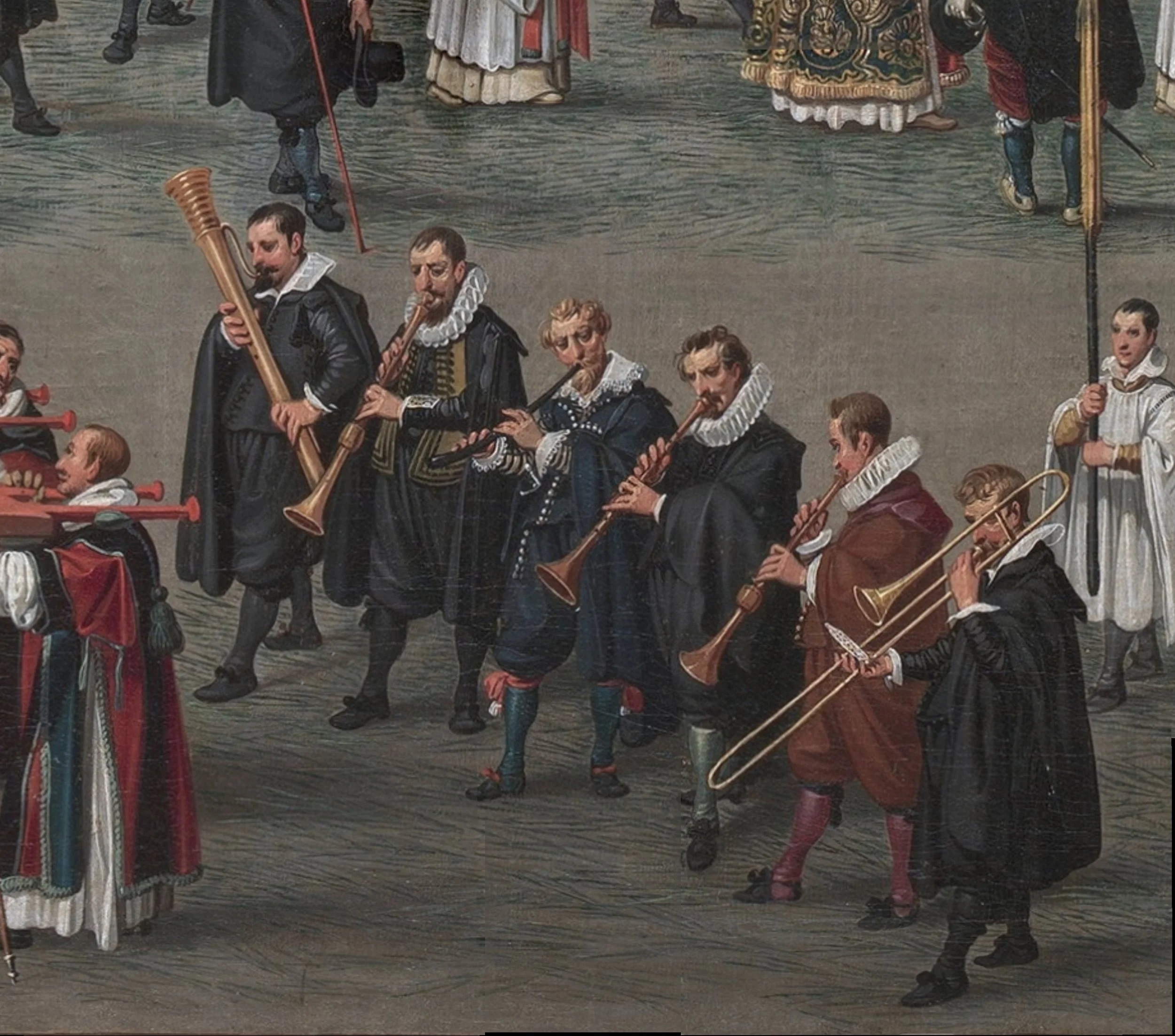
Gabrieli’s Sacrae Symphoniae of 1597 is a collection of sixty-one pieces for various choirs of instruments and voices. The scale of these works—some scored for as many as three five-part choirs—attests to the musical forces available at the Basilica. Like many of Gabrieli’s sonatas in this collection, his Canzon per sonar duodecimi toni opens with a long-short-short figure of repeated notes that echoes through Choir I (voiced today by strings of the viol and violin families) before Choir II (a cornett and three sackbuts) interjects and pulls the whole ensemble into a triple-time dance. Following a return to duple time, Choir II takes up the opening motive again before transforming it in various ways. Later on, the two bass instruments anchoring each choir engage in a lively dialogue before the opening section returns to close the piece.

Gabrieli spent the last three years of his life teaching a young Heinrich Schütz, and Schütz’s work bears the footprints both of Gabrieli’s teaching and of the great musical changes that were afoot in Europe at the time, including an expanded harmonic palette, use of basso continuo, and gestures toward modern tonality. His Singet dem Herrn ein neues Lied imitates Gabrieli’s alternating passages of polyphony and homophony and flexible use of choral exchange. Schütz ventures beyond his teacher’s style, however, in his use of madrigalisms—such as his depictions of trumpets, trombones, and natural imagery—and heavy chromaticism. Schütz hews to tradition in the doxology, restating the opening material, bringing the two choirs together, and ending with a sustained plagal cadence.

Born sometime around 1510 in one of the French-speaking realms, Dominique Phinot evidently made his way to Italy in the early 1530s. By the 1540s, if not earlier, he entered the employ of the Duke of Urbino, gaining fame as maestro di cappella there. His setting of the Lamentations of Jeremiah is firmly rooted in the third maniera, though he displays a rare genius in the variation he obtains within it. Comprising six short movements, the work is a palindrome of sorts; movements I and VI, II and V, and III and IV all mirror each other in various ways. The opening entrances of the outer movements quote each other, as do the closing sequences of the second and fifth movements.

Phinot reserves his most striking writing, however, for the two middle movements, isolating the treble voices in movement III and the bass voices in movement IV to create delicate webs of polyphony in close harmony. This arresting diversion from Phinot’s otherwise traditional canvas of antiphonal polychorality fittingly forms the core of the Lamentations, expressing its most desolate passages:

We have become orphans, fatherless;
     our mothers are like widows. 
We must pay for the water we drink;
     the wood we get must be bought. 
With a yoke on our necks we are hard driven; 
     we are weary, we are given no rest. 
We have given the hand to Egypt, 
     and to Assyria, to get bread enough.

In 1550, the Venetian publisher and composer Antonio Gardano issued a landmark collection of settings of the psalms commonly sung during Vespers services. The lion’s share of the music contained in this collection is by Willaert and Jachet, though it also includes works by Phinot and others. As these settings, adhering to tradition, are all based on their psalm’s plainchant, the sonic language each employs is primarily dictated by the mode of each psalm tone. We must therefore resist the modern expectations of tonal harmony as we listen. The Beati omnes collaboration between Jachet and Phinot, for instance, sounds somber to our modern ears, yet its text is full of joy, all of which is contained in a single, brilliant A major chord sounding just before the doxology. This fleeting moment vanishes with the very next tactus, as we revert to the chant melody’s dark fourth tone. Conversely, Willaert’s De profundis—setting one of the most desperate biblical texts—sounds bright and optimistic to us today. 

The next portion of our program consists of selections from this monumental collection. The first is Willaert’s Credidi, propter quod locutus sum, performed today not with voices, but by strings and winds alone. While there is little contemporary documentation of performance practices of this music, nothing about the known forces at San Marco or the musical ethos of the time would have prohibited such a performance. Even absent human voices, Willaert’s compelling contrapuntal writing, shimmering blocks of homophony, tasteful dashes of harmonic adventurism, and inexorable build to the final “Amen” hold up brilliantly. Willaert treats this motet’s fourth tone rather differently here, destabilizing it through deft use of musica ficta and unexpected plagal moves.

We then come to Jachet and Phinot’s remarkable Beati omnes – composed, like the other collaborative motets in this compilation, in the second maniera. It is not known whether Jachet (best known as Jacquet of Mantua) and Phinot composed their joint motet in person or via correspondence between Mantua and Pesaro, but to Beati omnes Jachet contributed Choir I (the odd-numbered verses of Psalm 128), while Phinot contributed Choir II (the even verses). Notable in this setting is Phinot’s introduction of an ear-tweaking modal shift at “et videas bona Jerusalem.” The doxology contains a nod to earlier generations of Franco-Flemish composers with the insertion of a quinta vox that echoes the chant melody in canon. Choir I’s material will be performed by a solo quartet today – a practice consistent with Sanmarcan tradition and preserved in Schütz’s later compositions for coro favorito and cappella

We then present another collaborative work, Jachet and Willaert’s Nisi Dominus, performed again by our Renaissance band. This setting of Psalm 127 is marked by persistent syncopation, even in the doxology, which features another canon. This portion of our program then concludes with a trio of motets by Willaert drawn from the final section of Gardano’s anthology. De Profundis stands out for its rich harmonies, effectuated by Willaert’s liberal use of ficta. Additionally, there are several elided cadences at choral exchanges, providing fleeting moments of dense polyphony. In convertendo Dominus follows in this same vein. Its opening triple-meter section, featuring both choirs in turn, suggests the dancing of the Israelites upon their homecoming from the Babylonian captivity. The rising motion that opens the chant melody predominates throughout, including a Baroque-style dotted ascending line in the bass of Choir II. Domine probasti me begins as Nisi Dominus’s opposite—stubbornly homophonic—though it eventually gives way to a series of duets between various pairs of voices, again hearkening back to the early Franco-Flemish composers. Its prevailing homophony then returns before the customary concluding eight-part polyphony. This work, sampling techniques spanning the first century of development of the spezzati idiom, is a fitting end to this portion of our program.

Two centuries after Willaert and his contemporaries brought the polychoral tradition to its first maturity, J.S. Bach penned some of the greatest examples of its evolved form. We close today’s program with perhaps the grandest of these, Singet dem Herrn ein neues Lied. Unlike the other works on today’s program, Bach’s opens with a joyful introduction deploying all eight voices. The second section features more traditional antiphonal exchanges, followed by a series of canonic duets in perhaps another nod to the Franco-Flemish School. The quintessentially Baroque second half of this first movement takes the form of an extended accompanied fugue, featuring the transfer of a melismatic subject across every part and ending with a partial recapitulation of the opening material.

The second movement—a chorale harmonization punctuated by a more florid four-part “aria” sung by our solo quartet—recalls the coro favorito–cappella texture codified by Schütz. The third and final movement then begins in the unexpected key of E-flat Major. Choirs I and II open the movement trading nearly homophonic material, but as these exchanges accelerate, the choirs come together before uniting for a concluding gigue-like fugue. Bach therefore brings the motet—and our program—to a close like the other works on today’s program: with clarity and climactic convergence.

by Nate Widelitz

CBS Announces Nate Widelitz As New Artistic Director

We are thrilled to announce that Nate Widelitz has been appointed as the new artistic director of the California Bach Society.

Nate Widelitz

Nate brings to CBS a deep passion for early music, a collaborative spirit, and an artistic sensibility grounded in both scholarship and performance. His values resonate fully with CBS’s long-standing identity—where our core focus on Baroque repertoire blends with adventures in Renaissance, Romantic, and modern works, brought to life with care and curiosity.

Before joining CBS, Nate served as the associate director of Choral Activities and visiting instructor of Choral Music Education at Millikin University in Decatur, Illinois, where he directed both the Collegiate Chorale and Treble Choir. He is also the founding director of the Five Cities Baroque Foundation & Festival, which he launched to create immersive early music experiences that unite musicians and audiences in regional communities.

His previous appointments include assistant conductor of both the Yale Glee Club and the Pacific Chorale, along with extensive performing and educational work with the Los Angeles Master Chorale, where he sang as both a soloist and a core ensemble member in partnership with the Los Angeles Philharmonic.

Nate holds degrees in Choral Conducting from Yale University (MM) and the University of Southern California (BM, Vocal Arts, summa cum laude), and he was a Fulbright Scholar at the Bulgarian Academy of Sciences. He is currently completing his Doctor of Musical Arts in Choral Conducting at Yale and is expected to receive the degree in October of this year.

We are proud to welcome Nate to the CBS family. His appointment affirms our commitment to artistic excellence and thoughtful programming—and opens a new chapter in our shared musical journey. We look forward to introducing you to Nate’s leadership in the 2025–2026 season and beyond.

As we look forward, we also extend our heartfelt thanks to the exceptional artists who guided us through this past season.

We are deeply grateful to Dr. Magen Solomon, our interim artistic director for the 2024–2025 season, and to Derek Tam, guest conductor for our December concert set, for their leadership, encouragement, and artistic integrity during this year of change. Their care, creativity, and spirit of collaboration shaped a season of depth and continuity, helping CBS navigate a time of transition with grace and generosity.

An innovative teacher, conductor, and champion of new music, Dr. Solomon brought decades of expertise in early and contemporary repertoire to CBS. Her extensive experience with leading ensembles across the country—and her lifelong dedication to engaging audiences, performers, and composers—brought wisdom, warmth, and a steady artistic hand to CBS during this interim period.

Derek Tam, praised for his deft conducting and thoughtful musicianship, brought elegance and insight to our December performances. As a key figure in the Bay Area early music scene, his presence helped reinforce CBS’s place within a thriving community of historically informed performance.

With gratitude, we thank them both for helping CBS move forward with confidence and clarity.

Meet Our Soloists for Brilliant Bach, May 2–4


BRILLIANT BACH

Borrowings and Transformations
May 2–4, 2025


Soprano Helene Zindarsian is admired for a voice that “goes straight to the heart of the listener.” A native San Franciscan, she made her professional debut as the soprano soloist in Mahler’s Des Knaben Wunderhorn with the San Francisco Ballet Company, after being “discovered” in Italy during an impromptu performance in a Sienese palazzo. Her Italian love affair continues in Sicily, where she is a regular guest artist with Filarmonica Laudamo, one of Italy’s most historic concert music societies.

A frequent soloist with Philharmonia Baroque Orchestra, Helene has been featured in Campra’s Requiem, Rameau’s Grand Motet, Handel’s Samson, Bach’s Christmas Oratorio, Vivaldi’s Gloria, Purcell’s Dioclesian, and Beethoven’s Choral Fantasy. Other solo highlights include Vaughan Williams’s Dona Nobis Pacem and Serenade to Music, Mozart’s Requiem, Haydn’s The Seasons and Lord Nelson Mass, Monteverdi’s Vespers of 1610, Handel’s Apollo and Daphne, Bach’s Magnificat, Cantata 131, and Missa Brevis in G Major, Faure’s Requiem, Berlioz’s Les nuits d’été, and Strauss’s Four Last Songs. She continues to enjoy longtime relationships with other local ensembles including American Bach Soloists, Cantata Collective, Marin Baroque, Marin Symphony, Marin Oratorio, and the San Francisco Symphony Chorus.


Filipino countertenor Kyle Sanchez Tingzon has been praised for his "powerful countertenor" (The Wall Street Journal) and "lovely, plummy voice" (Opera Today). Kyle appeared as soloist in last year’s California Bach Society concerts of the Biber Requiem, Steffani Stabat Mater, and Bach’s B Minor Mass

Other recent performances include work with American Bach Soloists, Philharmonia Baroque Chorale, his soloist debut with Pacific Opera Project in the US premiere of Vivaldi's Ercole su'l Termodonte, his debut with Tacoma Opera  in the world premiere of Tacoma Method, and his debut in Handel’s Rinaldo with Detroit Opera and The Glimmerglass Festival.

In 2022, Kyle completed his graduate and postgraduate studies in vocal performance, with a historical performance emphasis, at the San Francisco Conservatory of Music, studying under César Ulloa. While there, he made role debuts in Handel’s Giulio Cesare in Egitto (in the title role) and Monteverdi’s L’incoronazione di Poppea (as Ottone).


For eleven years, tenor Ben Pattison served as a musical diplomat with the U.S. Army Band, “Pershing’s Own,” performing for numerous heads of state and seven U.S. Presidents. He is the founder and host of Folks’ Music (folksmusic.org), an online series that celebrates communities and their cultures through music.

Some favorite performances include broadcasts to the International Space Station, PBS specials with the American Pops Orchestra (Wicked in Concert, United in Song), Super Bowl 50, the 2019 MLB World Series, the 10th World Symposium on Choral Music in Seoul, and appearances with the National Symphony Orchestra at Carnegie Hall and the Kennedy Center. He was also a finalist in the Kurt Weill Foundation’s Lotte Lenya Competition and spent four summers at Brevard Music Center and the Janiec Opera Company.

In addition to his performing roles, Ben spent six years as a site director with the elementary school music nonprofit, noteBUSTERS. He recently directed the Middle School Band at the Waldorf School of the Peninsula. Next week, he joins Maestra Solomon and the San Francisco Bach Choir for Mozart’s Requiem and Marianna Martines’ Mass #2.


Bass-baritone Ari Nieh began singing professionally while studying mathematics at UC Berkeley. After finishing her doctorate, she earned a master of music in historical performance from Longy School of Music. In 2024, she returned to the Bay Area, where her current season includes concerts with Philharmonia Baroque, California Bach Society, and Artists' Vocal Ensemble.

Ari's past oratorio solo highlights include Handel's Messiah and Bach's Magnificat with the Byrd Ensemble and Seattle Baroque Orchestra, as well as Bach's St. John Passion with Ensemble Musica Humana. Her favorite stage roles span many centuries, including Theseus in Britten's A Midsummer Night's Dream, Sir Joseph Porter in H.M.S. Pinafore, Medoro in Handel's Orlando, and Devil in the Ordo Virtutum by Hildegard von Bingen. 

A seasoned chorister, Ari has also performed with Seattle's Byrd Ensemble; Philharmonia Baroque, AVE, and Volti in the Bay Area; The Thirteen in Washington, DC; and GRAMMY-nominated True Concord Voices and Orchestra in Tucson. As a church musician, she has been a staff singer at Church of the Advent and Grace Cathedral.


Jubilate Baroque Orchestra has been a fixture of the Bay Area early music scene for 35 years. Originally known as Magnificat Baroque Orchestra, Jubilate was formed in 1989 to provide period instrument accompaniment for Bay Area choirs and other arts organizations. In that capacity, Jubilate has given hundreds of performances with dozens of professional and community choirs, churches, and opera companies. In Spring 2023, Jubilate became a program of the San Francisco Early Music Society, allowing it to continue serving the community for many years to come.

Program notes for Brilliant Bach, May 2–4


BRILLIANT BACH

Borrowings and Transformations
May 2–4, 2025


The works on our Brilliant Bach program highlight the expressive range and stylistic breadth of Bach’s choral writing. His music speaks across centuries — regardless of belief — through its emotional force, formal clarity, and architectural beauty. These pieces offer not only spiritual depth, but a deeply human experience of reflection, wonder, and joy.

Today's program presents three choral works from different phases of Bach’s life. Each reveals a different facet of his approach to sacred music — early chorale-based counterpoint, festive adaptation, and polychoral writing.

Missa Brevis in G major, BWV 236 - Borrowings

Bach’s Missa Brevis in G major is one of four short masses that set only the Kyrie and Gloria, portions of the Latin Mass retained in Lutheran liturgy. Likely compiled in the late 1730s, these masses draw on movements from earlier Leipzig cantatas. Though Leipzig services were conducted in German, these Latin settings may have been intended for more cosmopolitan contexts, such as Dresden, where Latin remained in courtly use.

Bach used parody technique to adapt movements from cantatas BWV 17, 79, 138, and 179 to fit the Latin Mass text. This process involved more than simply changing the words; Bach reshaped vocal lines and phrasing to suit new meanings, creating a unified sacred work from diverse sources.

Some movements reflect the stylistic brightness of the galant style, with tuneful melodies and elegant phrasing that suggest Bach’s awareness of changing musical tastes. This blend of older counterpoint and a more modern style lends the work both gravitas and charm.

  • Kyrie – Adapted from BWV 179, the movement unfolds in calm imitative counterpoint. Its serene, even somber, texture underscores the plea for mercy.

  • Gloria – Presented in six sections:

    • Gloria in excelsis Deo – A jubilant chorus adapted from BWV 79, with vigorous orchestral writing.

    • Gratias agimus tibi – A lively bass solo from BWV 138, animated by flowing lines and a virtuosic melisma on the word gloria.

    • Domine Deus – A supple and gracious duet for soprano and alto from BWV 79, blending expressiveness with elegance.

    • Quoniam tu solus sanctus – A tenor solo from BWV 179, shaped with lyrical phrasing and gentle rhythmic motion.

    • Cum Sancto Spiritu – A joyful fugue from BWV 17, with energetic counterpoint bringing the mass to a vibrant close.

Though more modest than the Mass in B Minor, this Missa Brevis distills Bach’s sacred style into a compact and expressive form.

Der Geist hilft unser Schwachheit auf, BWV 226

Composed in 1729 for the funeral of Johann Heinrich Ernesti, this double-choir motet combines polychoral texture with expressive clarity. Despite its somber occasion, the music celebrates the sustaining power of the Holy Spirit with vitality and transparency.

The first movement sets a passage from Romans 8 in graceful triple meter. Antiphonal exchanges between choirs give way to a unifying fugue, bringing all voices together and symbolizing the Spirit’s unifying strength.

The second movement, Der aber die Herzen forschet, is a four-voice double fugue. Two contrasting subjects — one rising, one falling — are developed and then combined, reflecting the theme of divine insight into the human heart.

The work closes with a simple chorale: Du heilige Brunst, süßer Trost. In homophonic style, it brings the motet to a serene and reassuring conclusion.

Transformations

Before turning to Bach’s Christ lag in Todesbanden, we present several earlier versions of the chorale tune that inspired it. The sequence begins with the plainchant Victimae paschali laudes, followed by Christ ist erstanden, in a setting by Bartholomäus Gesius (c.1562–1613), and two versions of Christ lag in Todesbanden by Johann Walther (1494–1570) and Lucas Osiander (1534–1604). These works chart the evolution of the tune from chant to chorale and set the stage for Bach’s expressive reimagining in BWV 4.

Christ lag in Todesbanden, BWV 4

This early cantata, likely written in 1707 or 1708, was almost certainly intended for Easter. Based on Martin Luther’s hymn of the same name, it offers a meditation on the themes of death, redemption, and resurrection. Though modeled on the older chorale motet tradition, it already displays Bach’s emerging voice and emotional depth.

The cantata opens with a serious Sinfonia whose harmonies and pacing establish a mood of solemnity and reflection. The chorale melody is already present, foreshadowing its central role in the work.

Verse 1 introduces the tune in the soprano line, with imitative counterpoint below. The alla breve “Halleluja” section adds urgency — more anxious than celebratory.

Verses 2–4 form a dramatic progression:

  • Verse 2, a duet for sopranos and altos, evokes a sense of entrapment. The lines are tightly knit, suspended, and harmonically tense.

  • Verse 3, for tenors, marks a turning point. The vocal line gains motion and lift, reflecting the proclamation that Christ has broken death’s grip.

  • Verse 4, for full chorus, vividly depicts the battle between Life and Death. The altos hold the chorale tune while the other voices engage in animated fugal lines drawn from the same melody. The music builds to a triumphant unified “Halleluja.”

Verses 5–7 complete the emotional journey:

  • Verse 5, for basses, powerfully affirms Christ as the Paschal Lamb with striking and wide-ranging vocal lines.

  • Verse 6, a duet for sopranos and tenors, sparkles with triplets and dotted rhythms. Words like Sonne (sun) and Herz (heart) are painted with radiant musical gestures.

  • Verse 7, a simple four-part chorale, concludes the cantata in quiet confidence. Its final “Halleluja” offers peace and resolution.

Throughout the cantata, the recurring “Halleluja” refrains shift in character—from restrained to exultant—mirroring the spiritual and emotional journey from death to resurrection.

Closing Reflections

This program traces a path through Bach’s sacred music, from the economical elegance of the Missa Brevis, through the polychoral vitality of Der Geist hilft, to the stark beauty of Christ lag in Todesbanden. Each work reflects a different dimension of Bach’s choral voice—his ability to unify structure and emotion, tradition and innovation.

Though rooted in religious tradition, this music resonates across boundaries. Its architecture, color, and depth speak to listeners in search of meaning, uplift, or simply beauty. The devotional becomes human; the spiritual, universal.

~ Pat Jennerjohn