
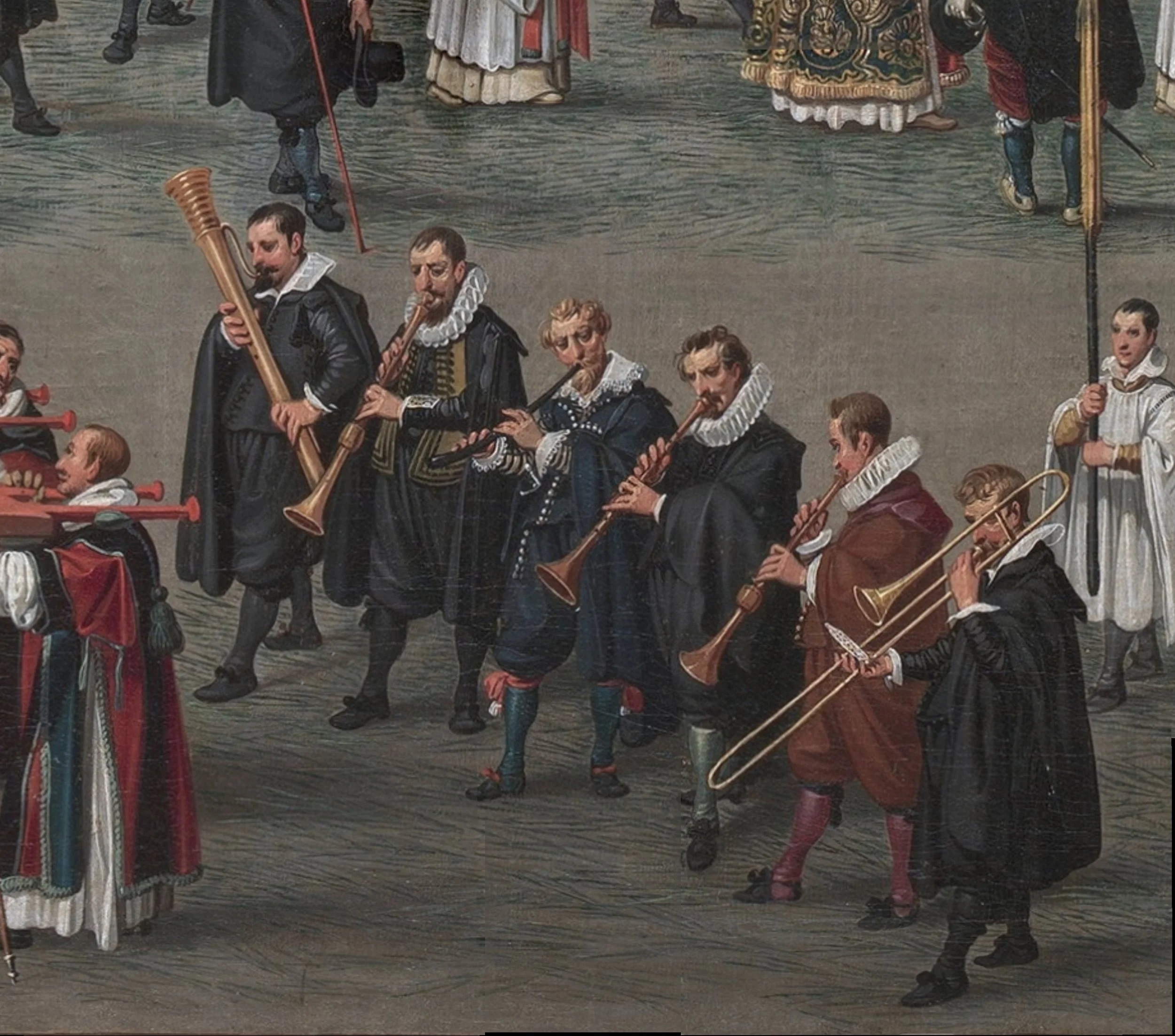
A sackbut, a cornetto, and a dulcian walked into a bar…
Or rather, into a 17th-century procession.
The image above, painted in Brussels around 1615, shows a group of musicians performing on instruments that would have been familiar to composers like Heinrich Schütz. Among them are the cornett, the dulcian, and the sackbut—an ensemble that might look unusual to modern eyes, but would have been entirely at home in the musical world of the early Baroque.
These instruments each bring their own distinctive voice. The cornett (or cornetto), a wooden wind instrument played with a small mouthpiece, has a bright, flexible sound often described as the closest instrumental match to the human voice. The sackbut, an early form of the trombone, offers a warm, resonant tone capable of both strength and subtlety. The dulcian, a predecessor of the bassoon, provides a rich, grounding bass line.
Far from being curiosities, these instruments are very much alive—and they’re part of the sound world we’ll be bringing to life in our upcoming concert.
At our final concert of the season, you'll hear the voices of CBS accompanied by a stellar band from the Jubilate Baroque Orchestra. You'll recognize the string instruments we'll have on hand, expertly played by Anthony Martin, Maria Caswell, and Farley Pearce, but we're delighted also to feature Steve Escher and Carlo Bendetti on Cornetto, Herbert Myers on Dulcian, and Richard van Hessel, Michael Cushing, and John Thomas on sackbut, in addition to our very own Yuko Tanaka on organ.
In Schütz’s music in particular, instruments and voices are closely intertwined. Rather than simply accompanying the choir, instruments often double vocal lines, answer them in dialogue, or help shape the dramatic character of the text. The result is a musical texture that feels alive and constantly shifting—at times grand and expansive, at others unexpectedly intimate.
It’s not quite what we think of as an “orchestra.” It’s something more conversational—and, at times, more theatrical.
For modern listeners, the timbres of these instruments may feel unfamiliar at first. But it doesn’t take long before they start to make perfect sense—blending with the voices in a way that feels both natural and a little bit magical.
When you hear them in concert, you may find that they don’t sound “old” at all— just different, and wonderfully alive.
Psalmen Davids
Three Centuries of Sacred Song
May 1–3, 2026

